

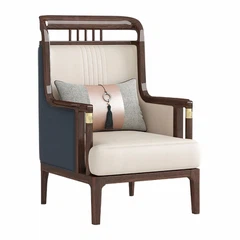
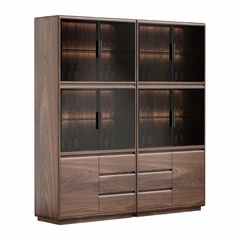
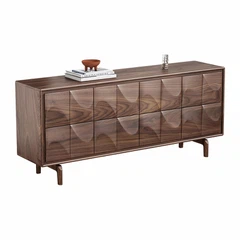
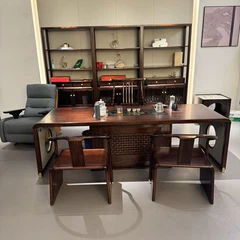

Overseas consumers are becoming increasingly attracted to furniture made in China, and behind this trend lies a profound transformation in China's furniture industry. In simple terms, China has evolved from a "world factory" that once competed mainly on low costs into a "global home-living innovator" that integrates supply chain strength, quality control, design innovation, and brand value.
To make this shift easier to understand, here is a comparison between the old perception and today's reality:
| Dimension | Past Perception (OEM Era) | Today's Reality (Brand / Ecosystem Era) |
|---|---|---|
| Supply Chain | Scattered and inefficient single-point operations | Highly coordinated industrial clusters with a "30-minute supporting supply circle," giving China global advantages in cost control and response speed |
| Products | Cheap, homogeneous mass-market goods | Boutique products with strong cost-performance value, innovative design, and even personalized customization |
| Quality Control | Vague standards and unstable quality | Quality standards increasingly defined and safeguarded according to global consumer expectations, with near zero tolerance for defects |
| Industry Role | Passive order taker and executor | Active innovator and trendsetter, exporting green standards, smart technology, and lifestyle concepts to the world |
More specifically, this growing preference is built on four solid foundations:
Foundation 1: Irreplaceable Strength in the Industrial Supply Chain
The competitiveness of Chinese furniture begins with the scale effect and extreme efficiency of its industrial clusters. Take steel furniture in Pangcun Town, Luoyang, Henan, as an example. The area has developed an astonishing "30-minute supporting supply circle": except for steel itself, all the necessary components for production-locks, glass, powder coating materials, packaging, and more-can be sourced within half an hour.
This highly concentrated supply chain creates two major advantages:
Extreme cost efficiency: For the same steel filing cabinet, prices in Luoyang are 10% to 15% lower than those of many southern manufacturers, creating what is widely known as the highly competitive "Pangcun price."
Rapid response capability: "Customer needs can be collected within a week, and new products can be launched within a month." This speed of iteration is astonishing to overseas buyers and consumers who are used to much longer production cycles.
Foundation 2: From "Usable" to "Excellent" - Quality and Value for Money
Today, Chinese furniture is no longer synonymous with "cheap disposable goods." On e-commerce platforms, the words most frequently used by overseas consumers in positive reviews are "good quality," "eco-friendly," and "affordable." Behind these comments is a nearly rigorous pursuit of quality by Chinese manufacturers.
For example, after furniture companies in Anji shifted toward a direct-to-consumer model, one company faced an 8% return rate. Instead of raising prices, it upgraded key components from plastic to more costly steel at its own expense, eventually reducing the return rate to 1.5%. This commitment to quality and value for money has helped Chinese furniture earn the trust of the international market.
Foundation 3: Innovation and Design That Match Global Demand
Chinese furniture companies are becoming increasingly consumer-oriented. Instead of producing in isolation, they now use data analysis and market insight to accurately identify global consumption trends and turn them into product innovation.
Smart integration: In response to demand for smart home products in Europe and the United States, companies have developed smart bedside tables with motion-sensor lighting and wireless charging functions.
Scenario-based segmentation: As remote work becomes more common, manufacturers have introduced office chairs that combine ergonomics with aesthetics. As outdoor living culture grows, they are also turning outdoor spaces into a "second living room" by launching high-quality outdoor furniture collections.
Cultural customization: In Zhangshu, Jiangxi, some companies can even offer tailored solutions for different markets-for example, foldable furniture designed for space-saving needs in Singapore, or luxurious "grand style" dining tables created for Saudi customers.
Foundation 4: From "Selling Products" to "Selling Brands" Through Global Expansion
The most important shift is that Chinese companies are no longer satisfied with being low-end OEM manufacturers at the bottom of the value chain. Through cross-border e-commerce and other new channels, they are now building their own brands and speaking directly to global consumers.
As industry experts have pointed out, Chinese furniture is moving from simply exporting products to exporting standards and ecosystems. This means that when overseas consumers buy a piece of Chinese furniture, they are not just purchasing an item. They are choosing a complete lifestyle solution that combines sustainability, health, smart technology, and Chinese aesthetics and innovation.